
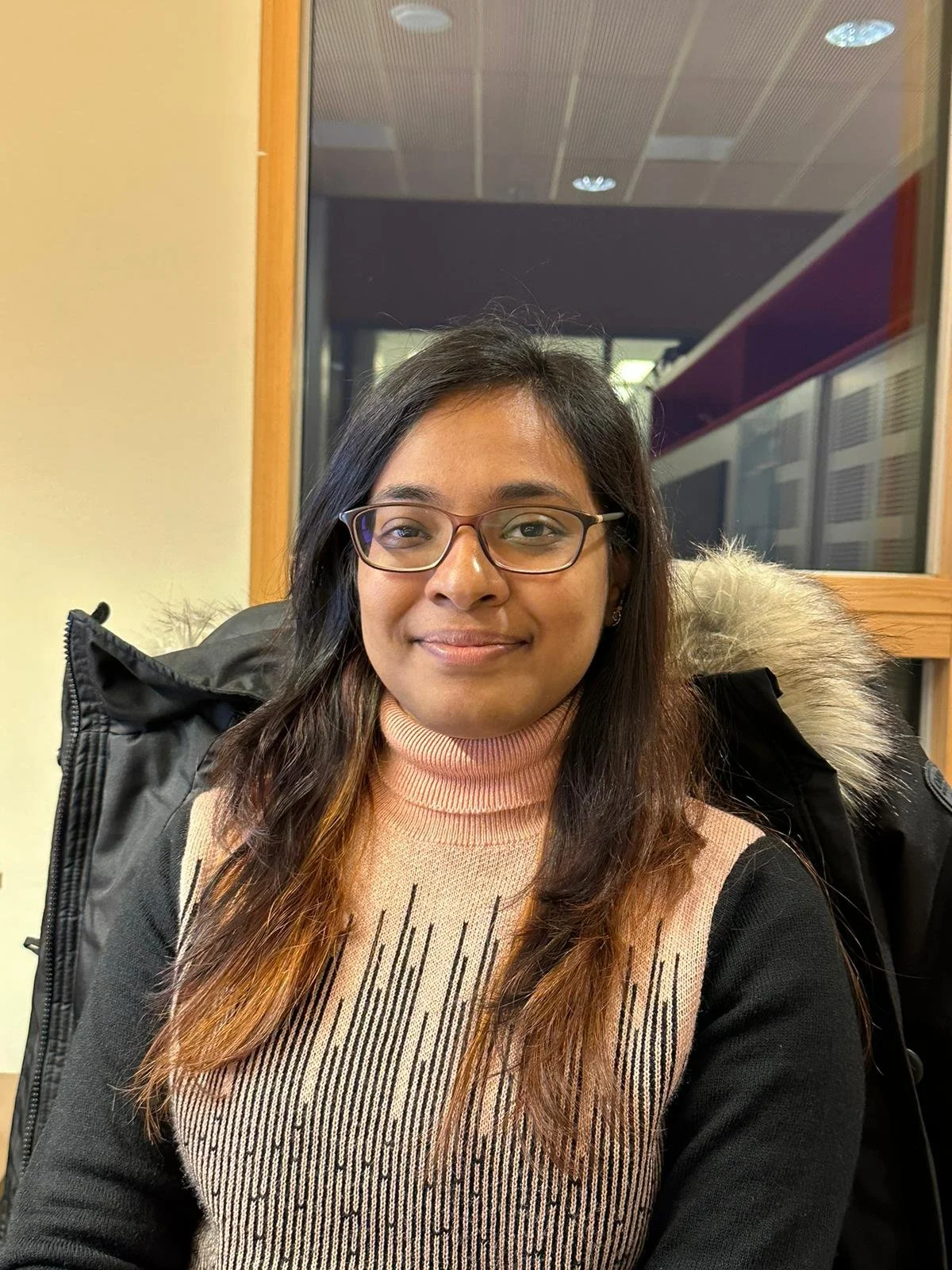
Karthika Korumadathil Shaji
PhD Candidate | SUGAR Lab
Biography
Karthika Korumadathil Shaji is a PhD researcher in the SUGAR Lab at the University of Groningen, since 2023, specializing in the development of high-sensitivity analytical methodologies for glycomics. Her research focuses on advancing capillary electrophoresis coupled to mass spectrometry (CE-MS) for the characterization of complex glycan structures from extremely limited biological material. A particular emphasis is placed on the development of robust strategies for N- and O-glycan analysis, including improved glycan release, sample preparation, chemical labelling, and electrophoretic separation.
One of the central challenges addressed in her work is the characterization of glycans from small, spatially defined tissue regions, where conventional analytical techniques are often limited by sample requirements and insufficient sensitivity. By combining CE-MS method development with laser microdissection (LMD), Karthika aims to enable detailed glycan profiling of specific tissue regions and cellular populations. Her research is particularly directed towards investigating glycosylation alterations associated with head and neck cancers. Ultimately, her work seeks to bridge the gap between analytical method development and biologically relevant applications, bringing high-resolution glycomics closer to individual cells and spatially resolved tissue analysis.
Research interests:
Capillary Electrophoresis–Mass Spectrometry (CE-MS) · Ultra-low-input Glycomics · O-Glycomics · Laser Microdissection · Glycan Labelling Strategies
Current Research
-
Korumadathil Shaji, K., Horvatovich, P.L., Lageveen-Kammeijer, G.S.M. Navigating the glycomics landscape with CE-MS: advances in sample preparation and analytical strategies. Analyst 2026, 151, 4902–4940. DOI: 10.1039/D6AN00304D
-
Xiao, R., Zheng, J., Loponte, H.F.B.R., Ding, Y., Gross-Valle, C., Derks, T.G.J., Horvatovich, P.L., Heiner-Fokkema, M.R., Bakker, B.M., Wolters, J.C., Lageveen-Kammeijer, G.S.M. Decoding the Glycan Signature: Unraveling N-Glycosylation Alterations in Glycogen Storage Disease Ia and Ib. bioRxiv 2025. DOI: 10.1101/2025.10.23.684118
-
2026 | CE Forum, Liège, Belgium | Oral Conference Presentation
From Method Development to Tissue Application: Ultra-low-input CE-MS-based N- and O-Glycan Profiling of Bulk and Spatial Head and Neck Cancer Tissues.
2026 | International Mass Spectrometry Conference (IMSC), Lyon, France | Poster Presentation
From Method Development to Tissue Application: Ultra-low-input CE-MS-based N- and O-glycan Profiling of Sinonasal Mucosal Melanoma.
-
Item description
-
Item description
Affiliations:
University of Groningen, SUGAR Lab, Analytical Biochemistry
Research period at the SUGAR Lab:
2023 - present
Supervision & Collaboration:
Developing Ultra-sensitive CE-MS Workflows for N- and O-Glycomics
Glycosylation is one of the most complex and structurally diverse post-translational modifications. The characterization of glycans is particularly challenging when only small amounts of biological material are available, or when structural features such as branching, linkage position, and isomerism need to be distinguished. Karthika's research focuses on overcoming these limitations through the development and optimization of CE-MS workflows.
Her main research activities include:
1. Ultra-low-input CE-MS glycomics
Developing sensitive analytical workflows for the detection and characterization of released glycans from increasingly limited sample quantities, with the long-term objective of enabling glycomics at the single-cell level.
2. Development of O-glycomics strategies
Investigating suitable approaches for releasing, preparing and analyzing O-linked glycans using CE-MS. A central challenge is establishing workflows that provide sufficient recovery, sensitivity and structural information while remaining compatible with very small samples.
3. Glycan labelling and derivatization
Evaluating chemical labelling strategies to improve glycan detection, separation efficiency, migration behaviour and structural characterization. Particular attention is given to reducing-end derivatization and its compatibility with CE-MS workflows.
4. Spatial glycomics using laser microdissection
Combining laser microdissection (LMD) with CE-MS to study glycosylation in selected tissue regions, thereby moving beyond conventional bulk tissue analysis towards spatially defined molecular information.
5. Applications in cancer research
Applying the developed methods to investigate N- and O-glycan profiles in head and neck cancer tissues, including sinonasal mucosal melanoma, with the aim of exploring disease-associated glycosylation heterogeneity.
Scientific Relevance
By improving analytical sensitivity and extending the applicability of CE-MS to multiple glycan classes, Karthika's research aims to make detailed glycomics accessible for biological samples that are currently difficult to investigate. These developments may provide new opportunities to study glycosylation heterogeneity across cells and tissue regions and help connect molecular glycan signatures with disease-related biological processes.
University of Groningen
Prof. Dr. Peter L. Horvatovich
Funding
Veni 2023
Links
Google Scholar: [Add link]
ORCID: [Add link]
LinkedIn: [Add link]